+ + + ENGLISH VERSION BELOW + + +

re-LABS @ re-VISION

Informationen zu den re-LABs der re-VISION
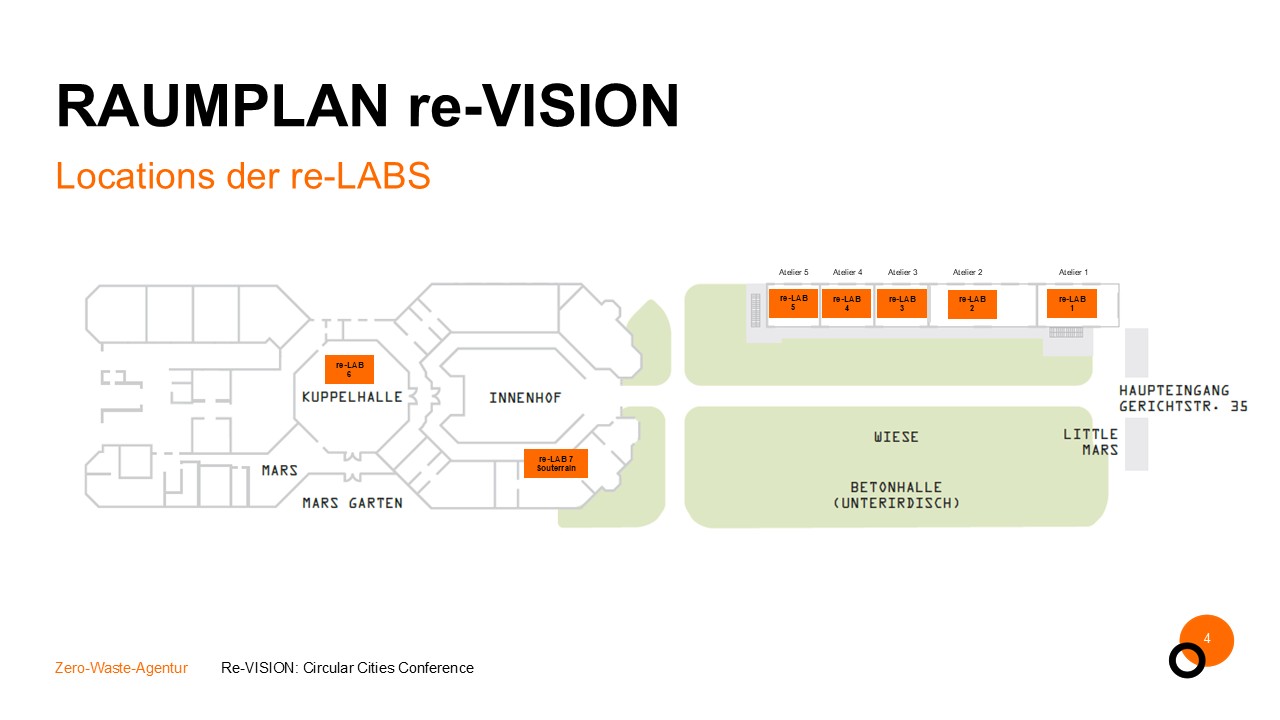
re-LAB Location

Im Programmpunkt „re-LABS“ der re-VISION: Circular Cities Conference 2026 werden konkrete Herausforderungen der zirkulären Stadt bearbeitet, die wir hier vorstellen.

Am Tag der Veranstaltung können sich alle Teilnehmenden vor Ort am Vormittag für ein re-LAB anmelden. Dazu erhalten alle vor Ort einen QR-Code und können sich registrieren. Hinweis: Die Teilnehmendenplätze sind jeweils begrenzt.
 

+++ re-LAB 1 | Raum: "Atelier 1" (max. 35 TN)
 

Circular Cities brauchen Wissen: Zirkuläre Bildungsstrukturen entlang der gesamten Bildungskette
Wie verhindern wir, dass Circular-City-Vorhaben am fehlenden Fachwissen scheitern?

Trotz zahlreicher Angebote zu Circular Economy und Kreislaufwirtschaft, von Schulmaterialien bis zu berufsbegleitenden Lehrgängen, fehlen in vielen Schlüsselbereichen der Circular City noch systematisch verankerte Kompetenzen, etwa in dualen Ausbildungen, im Handwerk, in Verwaltungen und relevanten Studiengängen. Das bremst die Umsetzung zirkulärer Ansätze.

Im re-LAB erarbeiten wir gemeinsam:
• wo (Schule, Ausbildung, Studium, Weiterbildung, non-formale Bildung) die größten Lücken liegen,
• welche Berufsgruppen besonders wirkungsstark sind,
• welche Bildungsformate diese Lücken schließen können.

Ziel ist eine übersichtliche Landkarte zentraler Kompetenzlücken und erste, konkret anschlussfähige Bildungsansätze für die Circular City.

Host:
Cradle to Cradle NGO, Lena Germscheid


+++ re-LAB 2 | Raum: "Atelier 2" (max. 40 TN)

Die Stadt als Rohstofflager: Materialkataster als Hebel
Wie lassen sich Gebäude und Infrastrukturbauwerke einer Stadt als „urbane Rohstofflager“ denken und was braucht es, damit daraus ein nutzbares Materialkataster für Städte wird?

Im re-LAB-Workshop arbeiten wir gemeinsam an folgenden Fragen:
• Welche Akteurinnen müssen in Städten (z.B. Berlin) an einen Tisch (Verwaltung, Wohnungswirtschaft, Planende, Entsorgerinnen, Digitalszene etc.)?
• Wie gut sind die vorhandenen Daten zu Gebäuden und Infrastruktur und wo liegen Lücken und Hürden?
• Wie unterscheidet sich die Situation der Datenlage in Neubau und Bestand?
• Welche Ansätze zum Datenmanagement eignen sich, um die urbanen Rohstoffbestände zu verwalten?
• Praxisübung:  Wir bauen eine Brücke, strukturieren Materialdaten und planen den Rückbau.
 
Ziel des Workshops ist ein gemeinsames Verständnis: Wie kommen wir von verstreuter Datenlage zu einem belastbaren Materialkataster, das Berlin befähigt, die gebaute Umwelt konsequent als Materiallager zu nutzen?

Host:
Madaster, Isabelle Armani


+++ re-LAB 3 | Raum: "Atelier 3" (max. 20 TN)
 

Materialbörse Bühne: Von der Idee zur Infrastruktur
Wie wird aus punktuellen Requisiten-Tauschbörsen eine verlässliche Kreislauf-Infrastruktur für den Kulturbereich?

Im re-LAB arbeiten wir am Beispiel einer digitalen Materialbörse für Theater, Oper und Film daran, wie Bühnenbilder, Bauteile, Möbel, Requisiten und Werkstoffe dauerhaft im Kreislauf gehalten werden können – über Institutions-, Sparten- und Trägergrenzen hinweg.

Wir arbeiten an den Fragen:
• wie staatliche und städtische Häuser verbindlich eingebunden werden können
• welche Governance- und Finanzierungsmodelle einen professionellen Dauerbetrieb ermöglichen
• wie Angebot und Nachfrage so skaliert werden, dass echte Materialkreisläufe entstehen
• welche Anreize, Standards und Prozesse die praktische Weitergabe erleichtern
• und unter welchen Bedingungen sich das Modell auf weitere Städte, Regionen und Kultursparten übertragen lässt.

Ziel ist es, konkrete Ansatzpunkte für eine tragfähige, übertragbare Re-Use-Infrastruktur der Kultur- und Kreativwirtschaft zu entwickeln.

Host:
Bayerischer Landesverband der Kultur- und Kreativwirtschaft BLVKK e.V., Jacqueline Heimgärtner


+++ re-LAB 4 | Raum: "Atelier 4" (max. 20 TN)
 

Smarte Strukturen im Bau: Blaupause für Dämmstoff-Rücknahme
Wie kommen Baustellen-Materialien zurück in den Kreislauf – ohne Extra-Stress fürs Handwerk?

Dämmstoffverschnitt entsteht auf nahezu jeder Baustelle. Doch bislang fehlen oft einfache, wirtschaftliche und verlässlich organisierte Wege, um das Material getrennt zu sammeln, zurückzuführen und weiterzuverwerten.

Im re-LAB entwickeln wir gemeinsam einen praxistauglichen Rücknahmeprozesse am Beispiel von Dämmstoff-Verschnitt auf Baustellen.
Im Fokus: Wie kann Sammlung und Übergabe für Handwerksbetriebe so einfach und niedrigschwellig wie möglich gestaltet werden – bei gleichzeitig hoher Materialqualität für Wieder- und Weiterverwerter?

Wir arbeiten mit konkreten Szenarien aus der Baustellenpraxis und fragen:
• Wie sehen alltagstaugliche Lösungen für Infrastruktur und Logistik aus?
• Welche logistischen Wege über Handel, Hersteller und Materialverwerter sind realistisch?
• Welche Anreize und Spielregeln braucht es, damit alle mitmachen?
• Und wie kann das Ganze als Modell auf andere Baumaterialien und Bundesländer übertragbar werden?

Ziel des Workshops ist es, eine praxistaugliche, übertragbare Blaupause für einen funktionierenden Rücknahme- und Weiterverwertungsprozesse von Dämmstoffverschnitten zu entwickeln, die im Anschluss in realen Projekten erprobt und weiterentwickelt werden kann.

Hosts:
Handwerkskammer Berlin, Carmen Albrecht
Hochschule für Wirtschaft und Recht / Projekt „Zukunft findet Stadt“, Leo Fenster
IVPU - Industrieverband Polyurethan-Hartschaum e.V., Thomas Herrschelmann 


+++ re-LAB 5 | Raum: "Atelier 5" (max. 20 TN)
 

Zirkuläre Nutzung von Freiflächen für kreislauffähige Städte: Wie Kommunen gemeinwohlorientierte Initiativen stärken können
Wie können Städte ihre raren Freiflächen so vergeben, dass sie sozialpolitische Bedarfe, Kreislaufwirtschaft und privatwirtschaftliche Interessen sinnvoll ausbalancieren?

Im re-LAB diskutieren wir anhand des Münchner Projekts „treibgut“ – einer Materialinitiative, die mit nur rund 200 m² innen und 375 m² außen bereits 80.000 kg Materialien pro Jahr umverteilt – welche Hürden und Spielräume kommunale Verwaltungen bei der Flächenvergabe haben.

Gemeinsam fragen wir:
• Wie können kommunale Flächen einfacher und niederschwelliger an gemeinwohlorientierte Kreislaufinitiativen vergeben werden?
• Welche Strukturen, Zuständigkeiten und Finanzierungsmodelle braucht es, damit zirkuläre Zentren mit 1.500–2.500 m² überhaupt möglich werden?

Im Workshop arbeiten wir heraus, welche rechtlichen, organisatorischen und finanziellen Anpassungen nötig sind, damit zirkuläre Orte realistisch plan- und betreibbar werden und kommunale Flächen als Hebel für eine resiliente, gemeinwohlorientierte Kreislaufwirtschaft genutzt werden können.

Host:
treibgut Materialinitiative gUG, Sophia Metzler, Jonaid Khodabakhshi


+++ re-LAB 6 | Raum: "Kuppelsaal" (max. 40 TN)
 

Circular Society in Aktion: Von der Idee zur politisch wirksamen Umsetzung
Wie wird eine Circular Society konkret – messbar, anwendbar, umsetzbar und politisch wirksam?

Im re-LAB arbeiten wir mit realen Fällen aus der Circular Region Südostniedersachsen und der Circular Rural Region im Landkreis Goslar: von Repair-Cafés über Baustoffbörsen bis zu regionalen Textilkreisläufen. An vier Thementischen diskutieren wir:
• welche Indikatoren eine Circular Society greif- und messbar machen,
• wie Wissenschaft und Praxis so zusammenkommen, dass beide gewinnen,
• was es wirklich braucht, um Konzepte in dauerhaft finanzierte, skalierbare Projekte zu überführen,
• wie Maßnahmen formuliert sein müssen, damit Politik sie aufgreift und umsetzt.

Ziel ist es, gemeinsam Kriterien, Indikatoren und konkrete Handlungsempfehlungen zu entwickeln, die direkt in laufende Forschungsprojekte, regionale Transformationsprozesse und politische Empfehlungen (u.a. Regierungskommission) einfließen.

Hosts:
TU Clausthal, Ani Melkonyan-Gottschalk, Professorin und Annika Hoppe, Wissenschaftliche Mitarbeiterin (Circular Region SüdOstNiedersachsen)


+++ re-LAB 7 | Treffpunkt Innenhof & transmediale studio  (max. 40 TN)
Dieses "re-LAB" teilt sich wie folgt auf:
 

Teil 1: 12:45 - 13:30 Uhr, Treffpunkt im Innenhof
"re-USE von Orten: Vom Krematorium zum Kulturquartier"

In einer Führung über das Gelände des silent green Kulturquartier erfahren Sie mehr über die  wechselvolle Geschichte des historischen Ortes: Das ehemalige Krematorium Berlin-Wedding gehört zu den denkmalgeschützten Gebäuden in Berlin und spiegelt die Stadtgeschichte auf einzigartige Weise wider. Zwischen 1909 und 1910 als erstes Krematorium der Stadt erbaut, zeugt das Gebäude seit über einem Jahrhundert vom Wandel der Bestattungskultur in Deutschland. Als das leer stehende Gebäude vom Berliner Senat zum Verkauf ausgeschrieben wurde, erhielt das silent green Kulturquartier Anfang 2013 den Zuschlag. Nach einer umfassenden Sanierung durch silent green (2013–2015), in enger Zusammenarbeit mit dem Berliner Denkmalschutz, hat das unabhängige Projekt hier seine Heimat gefunden.

Host: silent green


Dann Mittagspause: 13:30 - 14:30 Uhr, MARS Restaurant
 

Teil 2: 14:30 - 15:30 Uhr
"Circular City in Bewegung: Systemische Aufstellung als urbane Intervention" im transmediale studio

Dieses praktische re-Lap lädt dazu ein, das komplexe System einer Circular City mithilfe einer Systemischen Aufstellung wahrzunehmen und zu erkunden. Angelehnt an den systemisch-konstruktivistischer Ansatz von Insa Sparrer und Matthias Varga von Kibéd werden zentrale Elemente der Stadt, wie z.B.  Akteur:innen, Machtverhältnisse, Konflikte oder Potenziale – als „Stellvertretende“ im Raum positioniert. Durch ihre Wahrnehmungen und Rückmeldungen werden verborgene Beziehungen, Spannungen und Dynamiken sichtbar, die etablierte Routinen und lineare Logiken infrage stellen. So entsteht ein geschützter, zugleich politischer Experimentierraum, in dem urbane Transformationsprozesse körperlich, emotional und kritisch erfahrbar werden.

Gemeinsam schauen wir uns an, wo beim Aufbau zirkulärer Strukturen und Kreisläufe in der Stadt mögliche blinde Flecken liegen, dass könnten Verantwortungsketten, sozialer Gerechtigkeit, Teilhabe oder Governance sein. Darüber hinaus testen wir Lösungsansätze, wie diese Lücken geschlossen werden können. Der Workshop richtet sich an Menschen aus Verwaltung, Zivilgesellschaft, Bewegungen, Wissenschaft, Wirtschaft und Initiativen, die ihre Perspektiven einbringen, systemische Hebel identifizieren und den Wandel zu kreislauforientierten Städten bewusst und mutig mitgestalten wollen – unabhängig von Vorkenntnissen in Systemaufstellungen.

Host: Zero-Waste-Agentur, Meike Al-Habash


+++ ENGLISH VERSION +++

In the program item “re-LABS” of the re-VISION: Circular Cities Conference 2026 , concrete challenges of the circular city will be addressed, which we introduce here.

On the day of the event, all participants on-site can sign up for a re-LAB in the morning. For this, everyone on-site will receive a QR code and can register. Note: Participant spots are limited.

+++ re-LAB 1 | Room: "Atelier 1" (max. 35 participants)
 

Circular cities need knowledge: Circular educational structures along the entire education chain.
How do we prevent circular city projects from failing due to a lack of expertise?

Despite numerous offers on circular economy, from school materials to part-time professional courses, many key areas of the circular city still lack systematically embedded skills, for example in dual vocational training, craftsmanship, administration, and relevant degree programs. This slows down the implementation of circular approaches.

In re-LAB, we work together to identify:
• where the biggest gaps are (school, vocational training, university, continuing education, non-formal learning),
• which professional groups are particularly impactful,
• which educational formats can close these gaps.

The goal is a clear map of central skill gaps and the first, concretely applicable educational approaches for the circular city.

Host:
Cradle to Cradle NGO, Lena Germscheid


+++ re-LAB 2 | Room: "Atelier 2" (max. 40 participants)

The city as a resource storage: Material registers as a lever
How can buildings and infrastructure in a city be thought of as 'urban resource storage,' and what does it take to turn that into a usable material register for cities?

In the re-LAB workshop, we work together on the following questions:  
• Which players need to come together in cities (e.g., Berlin) – administration, housing industry, planners, waste managers, digital scene, etc.?  
• How good is the available data on buildings and infrastructure, and where are the gaps and obstacles?  
• How does the situation regarding data differ between new construction and existing buildings?  
• Which approaches to data management are suitable for managing urban material stocks?  
• Practical exercise: We build a bridge, structure material data, and plan the deconstruction.  

The goal of the workshop is to reach a shared understanding: How can we go from scattered data to a reliable material register that enables Berlin to consistently use the built environment as a material resource?

Host:
Madaster, Isabelle Armani


+++ re-LAB 3 | Room: "Atelier 3" (max. 20 participants)

Stage Material Exchange: From Idea to Infrastructure
How does a few one-off prop exchanges turn into a reliable circular infrastructure for the cultural sector?

At re-LAB, we're working on the example of a digital material exchange for theater, opera, and film to figure out how stage sets, components, furniture, props, and materials can be kept in circulation permanently—across institutions, genres, and organizations.

We're exploring questions like:
• how state and city-run venues can be reliably involved
• which governance and funding models make a professional, long-term operation possible
• how supply and demand can be scaled to create real material cycles
• what incentives, standards, and processes make practical sharing easier
• and under what conditions the model can be applied to other cities, regions, and cultural sectors.

The goal is to develop concrete starting points for a sustainable, transferable re-use infrastructure for the cultural and creative industries.

Host:
Bayerischer Landesverband der Kultur- und Kreativwirtschaft BLVKK e.V., Jacqueline Heimgärtner


+++ re-LAB 4 | Room: "Atelier 4" (max. 20 participants)

Smart structures in construction: Blueprint for insulation material take-back
How do construction site materials get back into the loop – without extra stress for the trades?

Insulation offcuts are created on almost every construction site. But so far, simple, cost-effective, and reliably organized ways to collect, return, and recycle the material are often missing.

At re-LAB, we’re working together to develop a practical return process using insulation offcuts on construction sites as an example.  
The focus: How can collection and handover be made as easy and low-threshold as possible for craftspeople—while still ensuring high material quality for recyclers and re-users?

We’re working with real-life construction site scenarios and asking:  
• What do practical solutions for infrastructure and logistics look like?  
• Which logistical paths via retailers, manufacturers, and material recyclers are realistic?  
• What incentives and rules are needed to get everyone on board?  
• And how can this model be transferred to other building materials and other states?

The goal of the workshop is to develop a practical, transferable blueprint for a working take-back and recycling process for insulation offcuts, which can then be tested and further developed in real projects.

Hosts:
Handwerkskammer Berlin, Carmen Albrecht
Hochschule für Wirtschaft und Recht / Projekt „Zukunft findet Stadt“, Leo Fenster
IVPU - Industrieverband Polyurethan-Hartschaum e.V., Thomas Herrschelmann 


+++ re-LAB 5 | Raum: "Room5" (max. 20 participants)

Circular use of open spaces for circular cities: How municipalities can support community-focused initiatives
How can cities allocate their scarce open spaces in a way that balances social policy needs, circular economy, and private interests?

In re-LAB, we discuss using the Munich project “treibgut” – a material initiative that, with just about 200 m² indoors and 375 m² outdoors, already redistributes 80,000 kg of materials per year – the hurdles and room for maneuver that municipal administrations have when allocating space.

Together, we ask:
• How can municipal spaces be allocated more easily and accessibly to community-oriented circular initiatives?
• What structures, responsibilities, and funding models are needed to make circular centers of 1,500–2,500 m² even possible?

In the workshop, we work out what legal, organizational, and financial adjustments are necessary so that circular spaces can realistically be planned and operated, and municipal spaces can be used as a lever for a resilient, community-oriented circular economy.

Host:
treibgut Materialinitiative gUG, Sophia Metzler, Jonaid Khodabakhshi


+++ re-LAB 6 | Room: "Kuppelsaal" (max. 40 participants)

Circular Society in Action: From Idea to Politically Effective Implementation
How does a Circular Society become concrete – measurable, applicable, doable, and politically effective?

At re-LAB, we work with real cases from the Circular Region Southeast Lower Saxony and the Circular Rural Region in the Goslar district: from repair cafés to building material exchanges to regional textile cycles. At four topic tables, we discuss: 
• which indicators make a Circular Society tangible and measurable,
• how science and practice can come together in a way that benefits both,
• what it really takes to turn concepts into permanently funded, scalable projects,
• how measures need to be formulated so that politics takes them up and implements them.

The goal is to jointly develop criteria, indicators, and concrete recommendations for action that flow directly into ongoing research projects, regional transformation processes, and political recommendations (including the government commission).

Hosts:
TU Clausthal, Ani Melkonyan-Gottschalk, Professorin und Annika Hoppe, Wissenschaftliche Mitarbeiterin (Circular Region SüdOstNiedersachsen)


+++ re-LAB 7 | Meeting-point: Courtyard & transmediale studio  (max. 40 participants)
Dieses "re-LAB" teilt sich wie folgt auf:

Part 1: 12:45 - 1:30 PM, meeting point in the courtyard
"re-USE of Places: From Crematorium to Cultural Quarter"

On a guided tour of the silent green Kulturquartier site, you will learn more about the eventful history of this historic location: The former Berlin-Wedding Crematorium is one of the listed buildings in Berlin and uniquely reflects the city's history. Built between 1909 and 1910 as the first crematorium in the city, the building has been bearing witness to the changes in Germany's burial culture for more than a century. When the vacant building was put up for sale by the Berlin Senate, the silent green Kulturquartier was awarded the contract in early 2013. After a comprehensive renovation by silent green (2013–2015), carried out in close cooperation with Berlin's heritage protection, this independent project has found its home here.

Host: silent green

Then lunch break: 1:30 PM - 2:30 PM, MARS Restaurant

Part 2: 2:30 PM - 3:30 PM
"Circular City in Motion: Systemic Constellation as Urban Intervention" at transmediale studio

This practical re-Lab invites you to perceive and explore the complex system of a Circular City using a systemic constellation. Based on the systemic-constructivist approach of Insa Sparrer and Matthias Varga von Kibéd, key elements of the city, such as actors, power relations, conflicts, or potentials, are positioned as 'representatives' in the space. Through their perceptions and feedback, hidden relationships, tensions, and dynamics become visible, challenging established routines and linear logics. This creates a protected yet political experimental space where urban transformation processes can be experienced physically, emotionally, and critically.
Together, we look at where there might be blind spots in building circular structures and cycles in the city—these could be chains of responsibility, social justice, participation, or governance. On top of that, we test approaches for how these gaps can be closed. The workshop is aimed at people from administration, civil society, movements, academia, business, and initiatives who want to bring in their perspectives, identify systemic leverage points, and actively and boldly shape the shift to circular cities—regardless of prior experience with system mapping.

Host: Zero-Waste-Agentur, Meike Al-Habash


Dabei sein! Be part!

Header-reVISION

re-VISION: Circular Cities Conference 2026

Shaping Urban Transformation for Resource Resilience

26. November 2026 | Berlin - hier mehr erfahren

November 26th, 2026 | Berlin - get more info here